
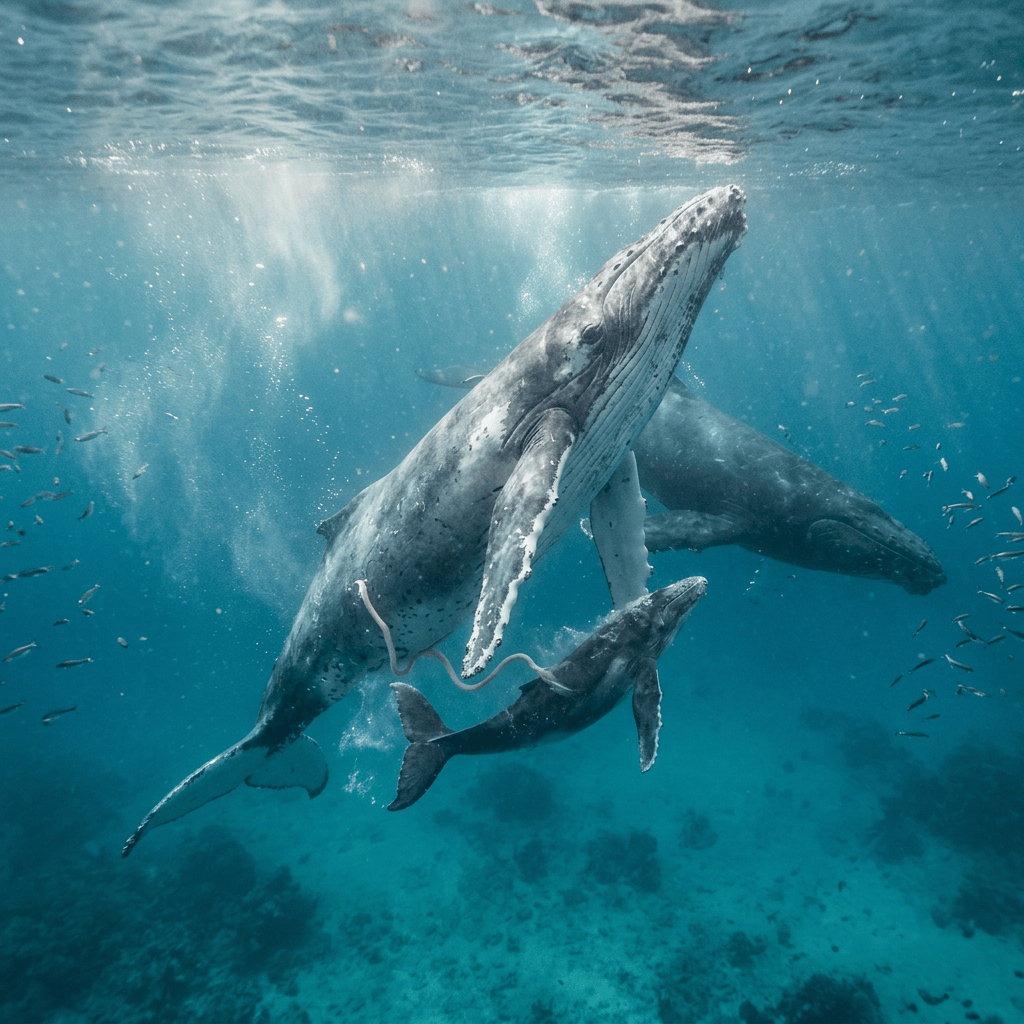
Humpbacks don’t have a midwife pod like sperm whales or orcas do — and it’s intentional. When a female is about to give birth she will deliberately lag behind or pull away from her migrating group. That Australian birth filmed in July near Kingscliff is a perfect example: the mother was moving “super slow, consistent, almost labored” and had fallen behind the rest of the pod when she gave birth about 700 meters from shore.
Incase you didn’t know-it’s the tail that comes out first not the head
There are a few reasons for that:
1. Humpbacks don’t live in tight family pods
Unlike orcas or sperm whales which live in stable matrilineal groups that protect each other, humpback pods are loose and temporary — they form and break up over hours or days during migration. There is no auntie network that stays to help. As photographers in Maui note: “A humpback mother gives birth alone” in the nursery waters.
2. Blood and noise attract predators
Birth releases a plume of blood and amniotic fluid — the drone pilot first thought a predator attack was happening when he saw red in the water. Being alone in shallow, warm, turquoise water near shore makes that plume dissipate faster and is harder for offshore orcas and sharks to find than if it happened in the middle of a big noisy group.
3. Avoiding males
Pregnant females migrate to warm breeding grounds like Hawaii and Silver Bank to give birth and nurse. Those same grounds are full of competitive males singing and fighting for mates. A newborn calf would get battered in that. Mothers seek the quietest, shallowest pockets to keep males away.
4. The calf needs quiet bonding
A newborn is 3-5 meters, 900-1,360 kg, and has to consciously swim to the surface to breathe from second one. In the Kingscliff footage the calf was described as having “little sense of direction” and just focusing on surfacing. If 10 adults were circling it would be chaotic. Alone time lets the mom and calf stay pectoral-to-pectoral and learn each other’s rhythm. The calf stays with her for ∼11 months after that.
Contrast this with the 2023 sperm whale birth researchers cite, where 10 females formed a protective circle and took turns pushing the calf up to breathe. Sperm whales need that because they are a deep-water, highly social species. Humpbacks evolved the opposite strategy: hide, give birth quickly and quietly, then leave.
So it’s not abandonment — it’s protection through isolation.
Hena’s Blog For Paws © 2019 by Hena Osman is licensed under CC BY 4.0


Leave a Reply