
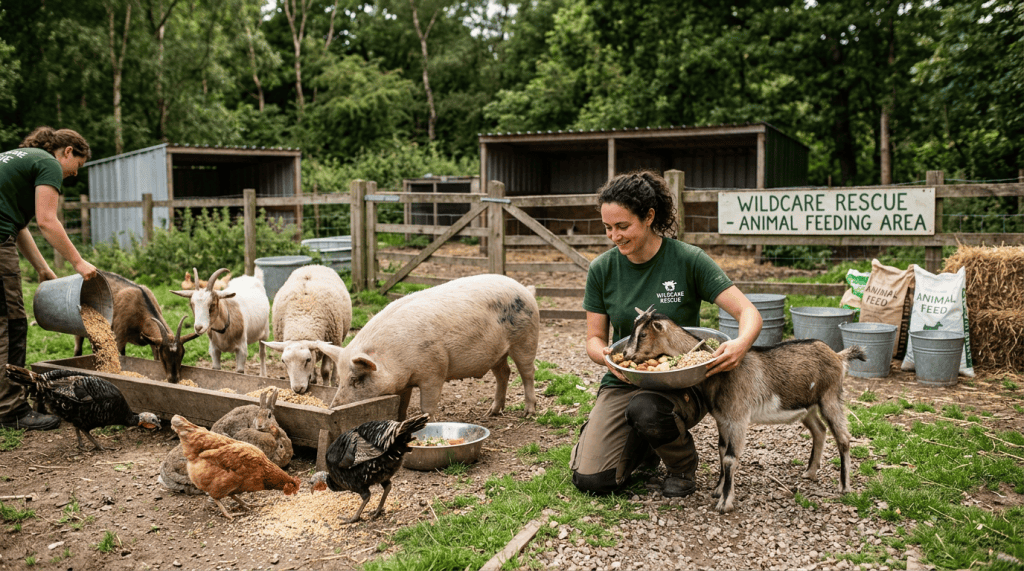
The Quran does not have one verse that says “feed the animals” in those exact words. Yet its message is clear. Animals are living communities created by Allah, they depend on Him for provision, and humans have a duty to treat them with mercy.Feeding a hungry animal, in Islam, is not just kindness. It is charity, responsibility, and a reflection of the mercy Allah asks us to show to all creation.
Animals Are Communities Like Us
The Quran gives animals a status that many people overlook.
“And there is no creature on [or within] the earth or bird that flies with its wings except [that they are] communities like you. We have not neglected in the Register a thing. Then unto their Lord they will be gathered.”
Surah Al-An‘am 6:38
This verse is the foundation for kindness to animals in Islam. It reminds us that animals are not objects. They have their own lives, needs, families, and communities. They feel hunger, thirst, fear, and pain, just as we do.
When we see a stray cat searching for food or a bird struggling in the heat, we are not looking at something insignificant. We are looking at a community that Allah created with purpose.
Allah Provides for Every Creature
“And there is no creature on earth but that upon Allah is its provision.”
Surah Hud 11:6
This verse teaches a beautiful truth. No creature is forgotten. Allah has already written provision for every living being.
When you place water outside for birds, or feed a hungry dog on the street, you become a means through which that provision reaches them. You are not giving from your own power. You are taking part in Allah’s system of care.
That is why feeding animals is seen as an act of worship, not just a good habit.
Food Was Created for Humans and Animals
“Then let mankind look at his food. How We poured down water in torrents, then We broke open the earth, splitting [it with sprouts], and caused to grow within it grain and grapes and herbage and olives and palm trees and gardens of dense shrubbery and fruit and grass, [as] enjoyment [i.e., provision] for you and your grazing livestock.”
Surah Abasa 80:24-32
Food, water, and land were not created only for people. They were created for all living beings. The rain that grows our wheat also grows grass for animals. The fruit we eat comes from the same earth that feeds birds, cattle, and wildlife. This verse reminds us that sharing provision is part of the natural order Allah designed.
Mercy Toward Creation
Throughout the Quran, Allah describes Himself as Ar-Rahman, the Most Merciful. The Prophet Muhammad ﷺ taught that showing mercy to creation brings Allah’s mercy in return.
That is why two famous Hadith are so often quoted alongside these verses. One tells of a woman punished for confining a cat and starving it. Another tells of a man forgiven for giving water to a thirsty dog. The Quran gives the principle. The Hadith shows how it applies in daily life.
What This Means for Us Today
In our streets, parks, and neighbourhoods, hungry animals are everywhere. A small act can make a big difference:
- Keep a bowl of clean water outside, especially in summer
- Leave leftover food for stray cats and dogs in a clean place
- Feed birds with seeds or grain instead of harmful scraps
- Never tease, chase, or throw stones at animals
- Teach children that animals feel pain and hunger
These acts may seem small, but in Islam, no act of mercy is small.
A Final Reflection
Feeding animals is not just about filling an empty stomach. It is about recognising that every creature has value in Allah’s eyes.
When we feed a hungry animal, we are not only helping that animal. We are softening our own hearts, teaching our children compassion, and living the mercy the Quran calls us to show.
In the end, kindness to animals is kindness to ourselves.
Hena’s Blog For Paws © 2019 by Hena Osman is licensed under CC BY 4.0


Leave a Reply