
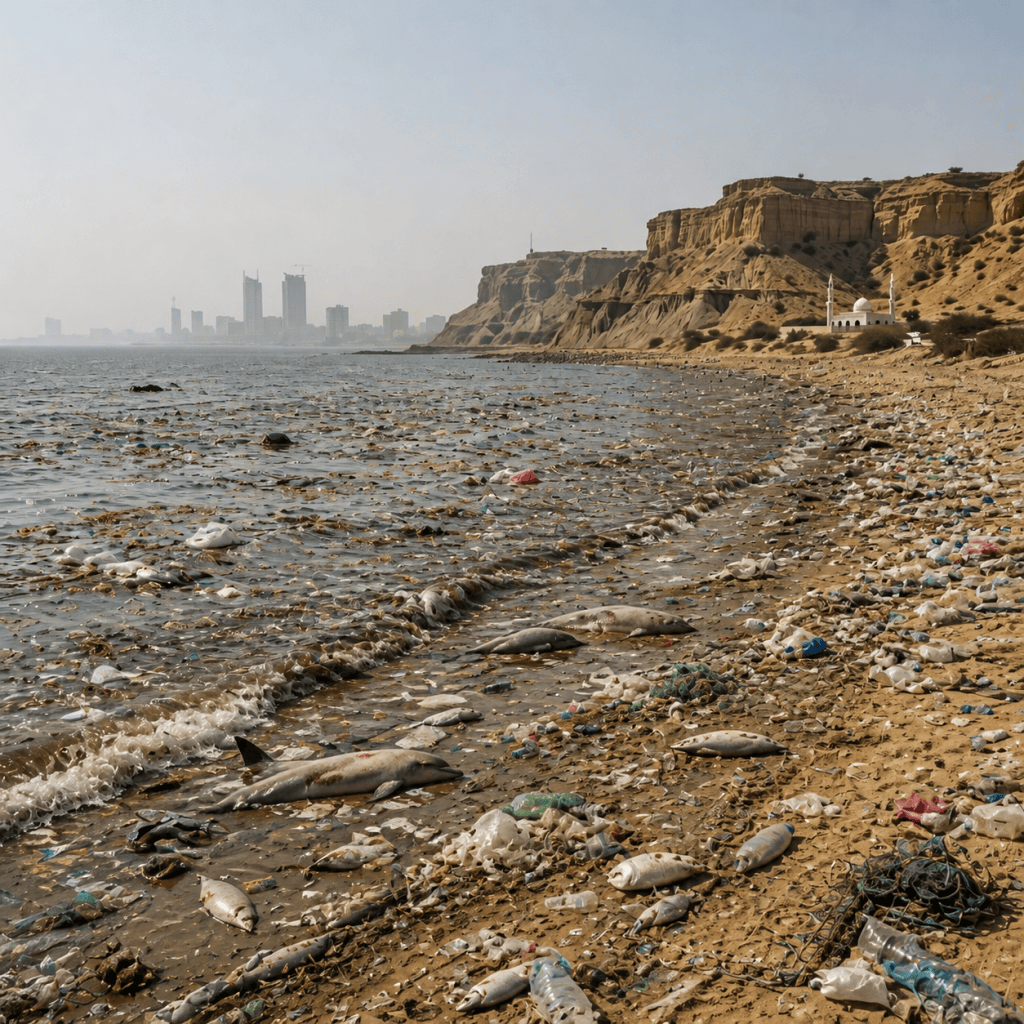
We have destroyed our sea not with a single catastrophic event, but with a thousand daily habits. The ocean that covers 71% of this planet, that makes half the oxygen we breathe, that fed us before we learned to farm — we have turned it into a dump, a mine, and a graveyard at the same time.
Do you know how we actually destroyed it?
1. We filled it with plastic that never leaves
Every year, 8 to 14 million tons of plastic enter the ocean. It doesn’t disappear. It breaks into smaller and smaller pieces.
A turtle sees a floating plastic bag and sees a jellyfish. A seabird feeds its chick bottle caps because they shine like fish eggs. A whale was found in the Philippines with 88 pounds of plastic in its stomach — grocery bags, rice sacks, banana plantation bags. It starved to death with a full belly. Now it’s in the micro-level. Plankton eat microplastics. Small fish eat plankton. We are finding microplastic in fish muscle, in sea salt, in human placentas. The sea didn’t absorb our trash. It returned it to us.
On coasts like the Arabian Sea, where cities meet the water with almost no waste treatment, you can see it at high tide: a line of shoes, syringes, shampoo bottles, fishing nets. That’s just what floats.
2. We emptied it
We have become too good at catching fish.
We drag massive trawlers with nets the size of football stadiums across the seafloor, scraping everything. We call it bottom trawling, but it’s really clear-cutting the ocean floor. Corals that took 500 years to grow are crushed in minutes.
We catch 80 million tons of wild fish a year, and we throw back 20% as bycatch — dolphins, turtles, juvenile sharks, dead and dying, tossed overboard because they weren’t the target. For every 1 kg of shrimp caught by trawl, we can kill up to 10 kg of other marine life.
Result: 90% of large predatory fish — tuna, sharks, swordfish — are gone compared to 1950 levels. The food chain is collapsing from the top down.
3. We poisoned it
The sea is the final drain.
Fertilizers from farms wash into rivers, rivers carry nitrogen to the sea. That nitrogen feeds algal blooms. The algae die, bacteria decompose them and consume all the oxygen. What is left is a dead zone where nothing can breathe. There are now over 700 dead zones worldwide, some larger than whole countries. Then there’s oil, not just from big spills that make the news, but from daily runoff, ship engines, and illegal tank washing. One liter of oil can contaminate one million liters of seawater.
4. We made it too loud, too hot, and too acidic
Marine life lives by sound. Whales talk across oceans. Dolphins hunt by echolocation. We have filled the ocean with engine roar, sonar, seismic blasting for oil exploration that is louder than a rocket launch. A seismic airgun can be heard 4,000 km away. Whales beach themselves to escape the noise. Their communication is drowned out.
At the same time, the ocean has absorbed 90% of the excess heat we’ve created and 30% of our CO2. That sounds helpful, until you realize the price. Hotter water means coral bleaching. The Great Barrier Reef has bleached five times in the last nine years. Warmer water also holds less oxygen and forces fish to migrate, breaking entire ecosystems. More CO2 means more acidic water. The pH has dropped 30% since the Industrial Revolution. For creatures that build shells — oysters, mussels, corals, tiny pteropods that are the base of the polar food chain — their homes literally dissolve.
5. What we are losing
This isn’t just about saving cute dolphins. When we destroy the sea, we destroy the systems that keep us alive.
- 50-70% of our oxygen comes from marine phytoplankton
- 3 billion people get their primary protein from the sea
- Coral reefs, which cover less than 1% of the ocean floor, support 25% of all marine species
We are not just killing animals. We are dismantling the planet’s life support.
So what now?
The ocean can still recover, and it recovers fast when we let it.
- Stop the flow of trash. A simple cloth bag, saying no to single-use cutlery, proper waste segregation at home. In coastal neighborhoods, community beach cleanups actually work because most beach plastic is local.
- Eat the sea with care. Ask where your fish comes from. Avoid juvenile fish, avoid shrimp caught by trawl, support local small-scale fishermen who use lines and nets that don’t destroy the bottom.
- Give it space. Marine Protected Areas where no fishing is allowed work astonishingly well. Fish populations can double in 3-5 years inside them.
- Fix what we flush. Support sewage treatment, don’t pour oil, paint or medicines down the drain. What goes down our sink ends up in their home.
- Lower the pressure. Every fraction of a degree of warming we prevent is oxygen for the sea.
The sea was here long before us. It doesn’t need us to save it. It needs us to stop attacking it.
We used to look at the horizon and see infinity, an ocean so big it could absorb anything. Now we know it absorbed everything — and it’s full.
Hena’s Blog For Paws © 2019 by Hena Osman is licensed under CC BY 4.0


Leave a Reply